 |
 |

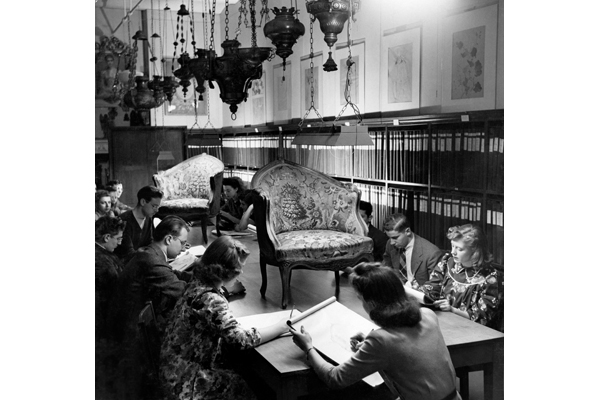
The Cooper Union Museum for the Arts of Decoration opened inside the Foundation
Building in 1896. Peter Cooper had stipulated exhibition space for the Cooper Union in his Deed of Trust 40 years earlier, but financial concerns initially waylaid those plans.
After visiting several prominent European museums, Abram Hewitt's daughters decided to open a similar institution in New York that could support the art school's instructional courses. In 1895, the Board of Trustees set aside gallery space on the fourth floor.
Because of their social status, the Hewitt sisters were able to attract many donors, and the museum's collection grew rapidly. One of the first major purchases was the Piancastelli collection of 4,000 drawings from the 17th and 18th centuries. These were the basis for the prints and drawings collection, which eventually grew to more than 50,000 works on paper.
In 1907, the Hewitt sisters formed a council to help run the museum. To honor Ms. Eleanor Hewitt, who died in 1924, the Council floored over the open space above the reading room, greatly increasing exhibition space.
In 1933, the museum hired Calvin S. Hathaway as assistant curator. Hathaway catalogued the entire collection and mounted exhibitions that spotlighted the Museum's holdings. He became the Museum's curator in 1946, and its director in 1951.
In 1961, needing funds to develop the school's educational programs, the trustees decided that the Museum was no longer financially viable. On July 3, 1963, the Museum closed to the public. A committee to save the museum recommended that it be spun off as a separate entity and led by a new charitable organization. On October 9, 1967 the Trustees and the Smithsonian Institution announced an agreement to transfer the Museum, under the provision that the collection and library remain intact and in New York City. The collection moved to the Carnegie Mansion on 5th Avenue and 91st Street, and the Cooper-Hewitt, National Design Museum opened in 1976.